
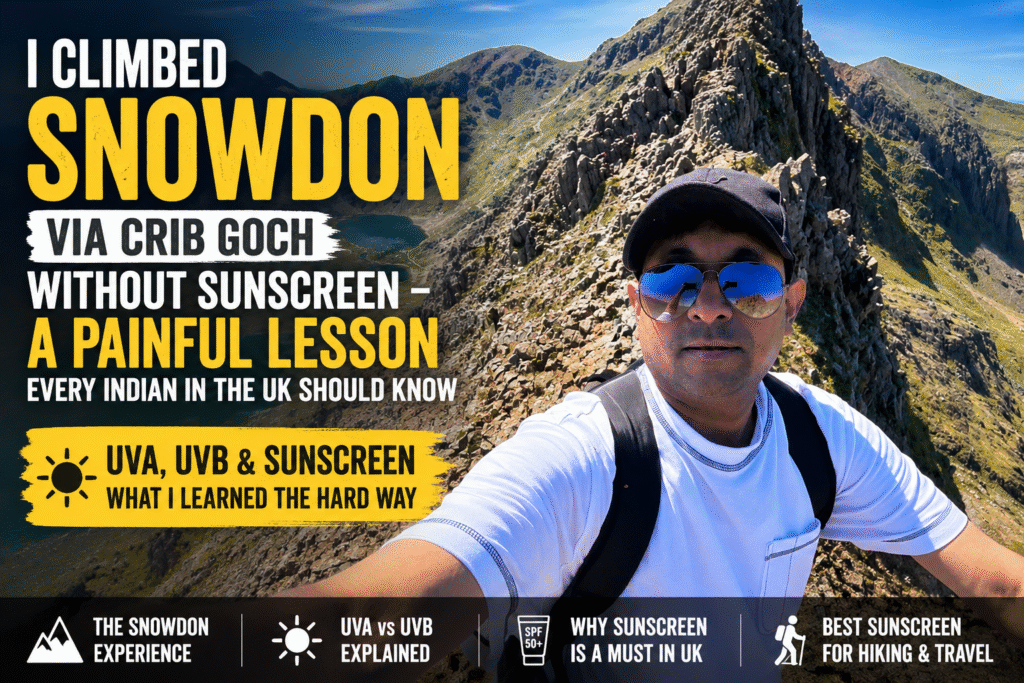
As an Indian who spent more than 30 years living under the sun in Gujarat, I never imagined that one of my biggest lessons about sunlight would come from a mountain in Wales.
Like many Indians, I grew up believing that sunscreen was optional. Back home, temperatures often crossed 35°C or even 40°C, and yet I rarely used sunscreen. So when I moved to the UK and saw temperatures around 15°C to 25°C, sunscreen was the last thing on my mind.
That belief changed completely after my recent hike to the summit of Snowdon via the famous Crib Goch route.
The Snowdon Adventure
The day was beautiful.
Blue sky, pleasant weather, cool mountain breeze, breathtaking views, and one of the most exciting ridge walks in the UK. The Crib Goch route is considered one of the most thrilling ways to reach the summit of Snowdon, requiring concentration, confidence, and a good head for heights.
The weather felt perfect. It wasn’t hot. I wasn’t sweating excessively. There was no feeling of burning heat.
As a result, I never even thought about applying sunscreen.
After all, this was Wales, not Gujarat.
Or so I thought.
The Surprise After Returning Home
When I returned home and looked at my left arm, I noticed something unusual.
The skin had become significantly darker than normal.
Initially, I assumed it was temporary and would disappear within a few days. However, even after several weeks, I could still see the effects. The skin remained darker and occasionally felt slightly warm compared to the surrounding area.
That was the moment I realized something important:
Temperature and UV exposure are not the same thing.
The weather may feel cool, but your skin can still receive significant UV damage.
Why the UK Sun Can Be More Dangerous Than Many People Think
This is especially important for Indians and other people moving to the UK.
Many of us unconsciously judge sunlight by temperature.
If it is 35°C in India, we think the sun is strong.
If it is 18°C in Wales, we think the sun is weak.
Unfortunately, UV radiation doesn’t work that way.
UV rays are invisible. You cannot feel them directly.
In fact, on a cool mountain day, you may not realize how much exposure your skin is receiving until the damage has already occurred.
Understanding UV Radiation
Sunlight contains different types of ultraviolet radiation.
The two most important are UVA and UVB.
UVB Rays – The Sunburn Culprit
UVB rays are primarily responsible for:
- Sunburn
- Redness
- Skin inflammation
- Blistering
- Immediate skin damage
When people return from a beach holiday with red skin, UVB rays are usually responsible.
UVA Rays – The Silent Damage
UVA rays penetrate deeper into the skin.
They are associated with:
- Skin tanning
- Skin darkening
- Premature ageing
- Wrinkles
- Long-term skin damage
Unlike UVB rays, UVA rays are present throughout the year and can penetrate clouds.
This means that even on cloudy days in the UK, your skin can still be exposed to significant UVA radiation.
The darkening of my arm after Snowdon was likely caused largely by UVA exposure.
Why Mountains Increase the Risk
Snowdon taught me another important lesson.
Mountain environments increase UV exposure.
As altitude increases:
- The atmosphere becomes thinner.
- Less UV radiation is filtered.
- Exposure becomes more intense.
In addition:
- Rocks reflect sunlight.
- Water reflects sunlight.
- Long hiking hours increase cumulative exposure.
During a mountain hike, you may spend six to eight hours continuously exposed to sunlight.
Even if the air temperature remains comfortable, your skin continues absorbing UV radiation.
India vs UK – A Common Misconception
Many Indians assume that sunscreen is more important in India than in the UK.
The reality is more nuanced.
In India
People often:
- Seek shade naturally.
- Stay indoors during peak afternoon heat.
- Cover themselves with clothing.
- Carry umbrellas.
Because the heat is obvious, people instinctively protect themselves.
In the UK
People often:
- Spend entire days outdoors.
- Go hiking.
- Visit beaches.
- Walk long distances in pleasant weather.
Because the temperature feels comfortable, people underestimate UV exposure.
This makes sunscreen just as important, and sometimes even more important during long outdoor activities.
What Does SPF Actually Mean?
SPF stands for Sun Protection Factor.
It measures protection against UVB radiation.
Approximate protection levels are:
- SPF 15 blocks around 93% of UVB rays.
- SPF 30 blocks around 97% of UVB rays.
- SPF 50 blocks around 98% of UVB rays.
- SPF 50+ provides the highest commonly available protection.
For everyday use, SPF 30 may be sufficient.
For hiking, cycling, beach visits, photography trips, and mountain adventures, SPF 50+ is a much better choice.
What Should Hikers Look For?
If you enjoy exploring the UK outdoors, choose a sunscreen that offers:
- SPF 50+
- Broad-spectrum protection
- UVA protection
- UVB protection
- Water resistance
- Sweat resistance
A sunscreen that feels comfortable to wear is also important because the best sunscreen is the one you actually use.
Which Sunscreen Would I Recommend?
After researching and learning from this experience, one product consistently appears among recommendations from hikers and outdoor enthusiasts:
P20 Sensitive Skin SPF 50+
Why?
Because it offers:
- Very high UVA protection
- SPF 50+ protection
- Water resistance
- Long-lasting performance
- Suitability for long outdoor activities
For mountain hiking, coastal walks, photography trips, and long summer days in the UK, it is an excellent choice.
My New Hiking Essential
Today, my hiking checklist looks different.
Before leaving home, I check:
✓ Water
✓ Snacks
✓ Camera
✓ Power bank
✓ Waterproof jacket
✓ Sunscreen
Sunscreen has become as important as carrying water.
Final Thoughts
My Snowdon adventure via Crib Goch gave me unforgettable memories, incredible views, and a valuable lesson.
For decades, I never considered sunscreen necessary.
One mountain hike in Wales changed that perception completely.
If you are an Indian living in the UK, or if you are visiting the UK for hiking and outdoor adventures, learn from my mistake.
Do not judge the strength of the sun by the temperature.
A cool mountain breeze can be deceiving.
Your skin may be paying the price long after the adventure is over.
The next time you head out for Snowdon, the Lake District, the Scottish Highlands, Durdle Door, or any beautiful corner of the UK, remember one simple rule:
Carry sunscreen, and use it before you think you need it.